MOSAIC Therapy
Ocular Movements and Alternating Stimulations for Cerebral Integration
Integrative therapeutic approach based on neuroscience

Definition and scientific context
MOSAIC therapy, co-founded in 2019, represents an integrative therapeutic approach based on 24 years of research conducted by Stephanie Khalfa, PhD in neuroscience, at CNRS Marseille. This work specifically focuses on the brain mechanisms of stress, emotions, and psychological trauma.
Since 2021, Dr. Khalfa has continued developing this method in a rigorous scientific approach, integrating recent advances in neuroscience and validating protocols through clinical studies.
Fundamental principle
The transformation of the traumatic imprint at the brain level without requiring direct re-exposure to trauma, relying on mechanisms of neuronal plasticity and memory reconsolidation.
Neurophysiological mechanisms
The MOSAIC method is based on three main mechanisms:
1. Alternating bilateral stimulations
Bilateral stimulations (acoustic, tactile or visual) generate neuronal activity that facilitates:
- Regulation of the amygdala and limbic system
- Activation of the prefrontal cortex promoting emotional control
- Interhemispheric synchronization facilitating information integration
- Reduction of sympathetic hyperactivation
2. Activation of positive internal resources
The protocol systematically includes the activation of positive resources allowing:
- Anchoring of feelings of safety and control
- Creation of new emotional response patterns
- Strengthening of emotional regulation circuits
3. Memory reconsolidation and brain plasticity
The therapeutic intervention mobilizes brain plasticity processes:
- Modification of emotional encoding associated with memory
- Reduction of affective load through reconsolidation
- Adaptive integration of experience into autobiographical memory
- Extinction of conditioned fear responses
Clinical applications and benefits

Observed benefits
Rapid symptomatic resolution
Clinically significant improvement observed in 1 to 3 sessions, without need for direct exposure to traumatic memories.
Reduction of post-traumatic manifestations
Measurable decrease in hypervigilance, startle reactions, memory intrusions and associated somatic manifestations.
Lasting emotional stabilization
Installation of adaptive emotional regulation patterns with long-term maintenance of benefits.
Developmental adaptability
Specific protocols validated for different age groups (children, adolescents, adults) with appropriate methodological adjustments.
Therapeutic indications
- Post-Traumatic Stress Disorder (PTSD)
- Generalized anxiety disorders
- Panic attacks
- Specific phobias
- Eating disorders
- Professional burnout syndrome
- Attachment disorders
- Chronic pain of psychosomatic origin
- Sleep disorders related to stress
- Reactive depression
Professional training
MOSAIC therapy training is designed for healthcare professionals and helping relationship practitioners wishing to enrich their clinical practice.

Benefits for professionals
Standardized protocol
Structured methodology in reproducible steps, facilitating integration into existing clinical practice.
Integrative compatibility
Compatible with established therapeutic approaches: EMDR, IFS, clinical hypnosis, CBT, psychodynamic and systemic approaches.
Extended field of application
Applicable to simple and complex traumas, anxiety disorders, eating disorders, addictions, relational and developmental issues.
Training program
Complete and structured pathway to master MOSAIC® therapy
Fundamental module
Acquisition of theoretical foundations and standard clinical protocol
Specialization modules
Specific applications (complex trauma, eating disorders, pediatric population, couples therapy)
Practical workshops
Clinical simulations and case studies
Clinical supervision
Individual and group support post-training
Continuing education
Regular updates integrating research advances
Scientific foundations
David Servan-Schreiber Prize 2019
Awarded to Dr. Stephanie Khalfa for her work on the neurophysiological mechanisms of bilateral stimulations and their therapeutic application.
Neurophysiological bases
Synaptic plasticity
Brain's ability to reorganize its neuronal connections
Memory reconsolidation
Modification of memory traces during their reactivation
Limbic regulation
Modulation of amygdala activity by the prefrontal cortex
Interhemispheric integration
Synchronization of bilateral brain networks
Main scientific publications
MOSAIC: A New Pain-Free Psychotherapy for Psychological Trauma
Sleep parameters improvement in PTSD soldiers after symptoms remission
Cracking the EMDR code: Recruitment of sensory, memory and emotional networks
Bilateral Alternating Auditory Stimulations Facilitate Fear Extinction and Retrieval
Integrative approach
MOSAIC therapy harmoniously integrates several validated therapeutic approaches:
EMDR
Eye Movement Desensitization and Reprocessing
Strategic brief therapy
Rapid and targeted solutions
Solution-focused therapy
Focus on resources and capabilities
Clinical hypnosis
Altered states of consciousness to facilitate change
Nonviolent Communication
Caring therapeutic relationship
Ego-state therapy
Ego-state therapy for parts integration
Internal Family System
Internal Family System for inner harmonization
Polyvagal theory
Autonomic nervous system regulation
Testimonials
Concrete transformations experienced by our patients


I had tried several therapies without success. With MOSAIC, I was finally able to free myself from my anxieties without having to tell everything in detail. It was exactly what I needed.
Camille, 38 years old
Generalized anxiety
After my accident, I couldn't drive anymore. In three sessions, I got my freedom back. It's incredible how the change happened naturally.
Marc, 45 years old
Driving phobia
MOSAIC allowed me to make peace with my past. I'm no longer a prisoner of my memories, I can finally move forward.
Lea, 29 years old
Childhood trauma
Frequently asked questions
Will I have to tell my trauma in detail?
No, that's precisely one of the advantages of MOSAIC. You don't need to relive or tell in detail your painful experiences.
How many sessions are needed?
Most people see significant improvement in 1 to 3 sessions. Some more complex situations may require a few additional sessions.
Are there side effects?
MOSAIC is a gentle method. You may feel slight fatigue after the session, a sign that your brain is working to integrate the changes.
Is it covered by insurance?
If your practitioner is a psychologist or psychiatrist, part may be covered. Check with your insurance provider.
Deepen your understanding of the MOSAIC® method
Discover the reference book to deeply understand the scientific foundations and practical application of MOSAIC® therapy
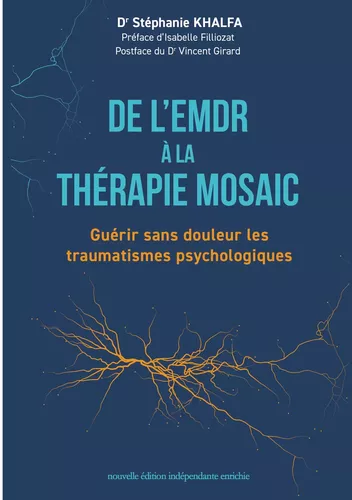
From EMDR to MOSAIC® therapy
Healing psychological trauma without pain
By Dr. Stéphanie Khalfa, CNRS Research Director
What you will discover:
- The neurophysiological foundations of MOSAIC® therapy
- The evolution from EMDR to a more integrative approach
- Clinical cases and concrete testimonials
- Clinical applications and therapeutic protocols
Join the MOSAIC community
For any information
Method / Research
contact@therapiemosaic.com